I help leaders make difficult change possible.
Product strategy, technology leadership, behavioral systems, and transformation work for organizations building something new, uncertain, or hard to define.

Book
Stone Soup Strategy - A Guide to Successful InnovationProduct
Single-Step - Motivational Software
Product
Rarify.org - FDA-Approved Diet Diary for Clinical TrialsProduct
Frog Breakfast - Task-Management SaaSProduct
ZenDiet.ai - Mindful Nutrition PlatformProduct
SensorLogic - IoT Device Management
Advisor
US, Europe, Middle East & Africa
Single-Step
Motivational software
Desktop software
Self Magazine coverage
Systems thinking for behavioral change
In 2003, Kenneth created Single-Step, a behavioral change software product built around motivation, progress, streaks, points, visual feedback, and personal accountability before those patterns became common product language.
Selling several thousand copies, he interacted with users and organizations, shaping his perspective on transformation efforts he has led: helping people move from intention to action, and helping teams turn uncertain work into something they can actually execute.
01 / Team motivation
Designing and implementing new software products, Ken was faced with the challenge of maintaining motivation across large teams with diverse skill sets. The skills, personalities, and motivations of each team member were critical over months and years of development cycles.
02 / Individual behavior
Ken took a sabbatical to backpack around the world, while designing single-step, a system to incorporate his ideas and lessons into a product.
single-step began with a simple, yet challenging question — what can people do to motivate themselves to do difficult things?
Moving from extrinsic to intrinsic motivation was a leap, and Ken developed early precursors to the gamification products that were to follow. Ken used the system on himself, tracking his progress through half-marathons, a sprint triathlon, and a full-marathon.
03 / Strategy execution
Returning to corporate consulting, Ken saw a recurring pattern. Organizations with strategies, but little ability to translate these strategies into frameworks for execution.
Teams, projects, programs, and departments were all working with independent systems, with wide degrees of success, motivation, and effectiveness.
04 / Product behavior
The opportunity to design Rarify provided Ken the opportunity to extend the lessons of single-step, extending the challenge into creating a sophisticated product system, one with deep constraints: clinical trials that required strict engagement and participation guidelines.
05 / Organizational behavior
Taking a break from building, Ken shifted to writing. Stone Soup Strategy collected the lessons and patterns into a framework for teams, transformation, coordination, and difficult change.
Published by Routledge in 2026, it tells the story of a small business working to cope with pressures from Artificial Intelligence, delivering Ken's framework in tandem with the story.
Ways I work with leaders and teams
Product Strategy
For organizations shaping a new product, clarifying the user problem, defining the early roadmap, and turning an uncertain idea into something a team can build.
Learn more →Technology Leadership
For companies that need senior product and technology judgment before they are ready to hire, or before they commit to a major build, vendor, platform, or architecture decision.
Learn more →Transformation Advisory
For AI, digital transformation, and organizational change efforts where the technical work is only part of the problem.
Learn more →Speaking & Workshops
For leadership teams, conferences, and organizations that need a clearer way to understand why hard work fails and how to create confidence before it does.
Learn more →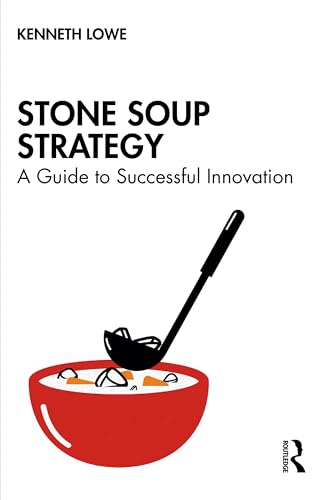
The framework behind the work.
Stone Soup Strategy uses game theory and behavioral economics as practical lenses for understanding how people contribute, hesitate, align, defect, and move through uncertainty together.
It is not a collection of war stories. It is a framework for making difficult change more understandable, more structured, and more executable.
“Stone Soup Strategy nudges leaders to make explicit choices about where to demand clarity (safety, ethics, regulatory constraints, budget guardrails) and where to preserve ambiguity (exact use cases, UX flows, process changes) so that genuine discovery remains possible.”
— Carl F.
“I've watched him work with a team of nearly three dozen nationalities and keep them all aligned.”
— Stuart W.
“His framework for behavioral systems completely changed how we structure our transformation efforts.”
— Name, Title, Organization
Selected work and experience







Common Questions
Questions leaders ask before difficult change begins
Why do digital transformations fail in SMBs?
Most digital transformations fail because organizations treat them as technology upgrades rather than behavioral shifts. The technical work is often the easiest part. Failure happens when leaders underestimate alignment, incentives, hesitation, and the human systems that determine whether teams contribute or protect themselves.
How can leadership teams address ambiguity in product strategy?
Leadership teams address ambiguity by turning unclear intent into structured, executable work. That means clarifying the problem, defining early priorities, creating visible progress, and building the conditions for teams to move forward before the full path is visible.
How do you innovate successfully when the path is unclear?
Innovation succeeds when leaders create a framework for action instead of waiting for certainty. Start with the behavior you need to change, define the smallest executable step, build feedback loops, and help people move from intention to action even when the destination is still forming.
What is the role of behavioral systems in organizational change?
Behavioral systems shape whether people contribute, hesitate, align, or protect themselves. In organizational change, progress depends less on announcing a new initiative and more on designing incentives, feedback, coordination, and accountability so the desired behavior becomes the easier path.
For difficult work that needs judgment.
If you are shaping a new product, leading a transformation effort, recovering a stalled initiative, or looking for senior product and technology leadership, start here.